Our final documentary turned out great, it almost is better than what we originally wanted to do. Being only given recordings of peoples voices mean Shauna had to be incredibly creative when it came to editing. I was able to recruit some people to write pieces about their love for The Beatles and when it came to it my Dad, Martin Swan, did some voice recording for us. This was essential as some participants didn’t want to have their voices used. The way to make this better in reflection would have been to have better quality sound recording equipment but it just wasn’t possible to get that equipment with the current climate.
Presentation
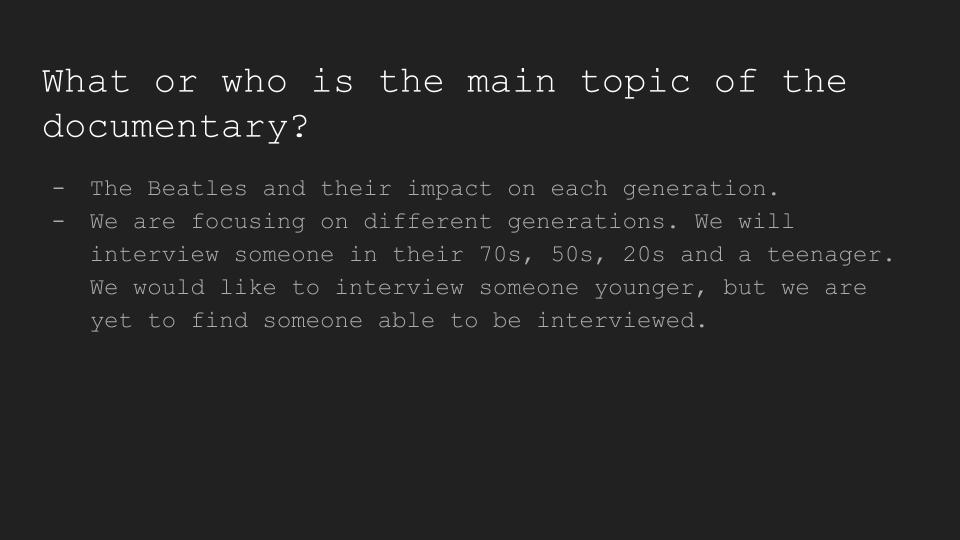
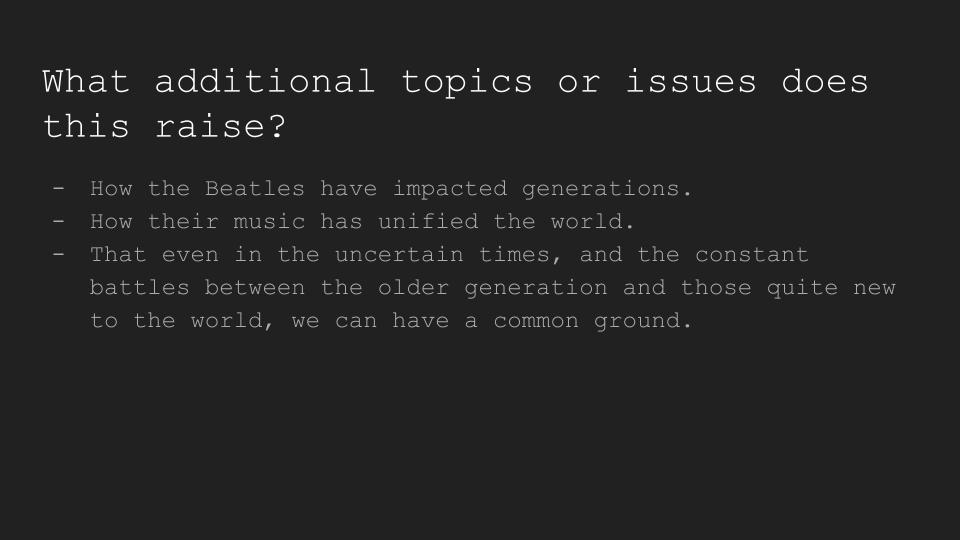
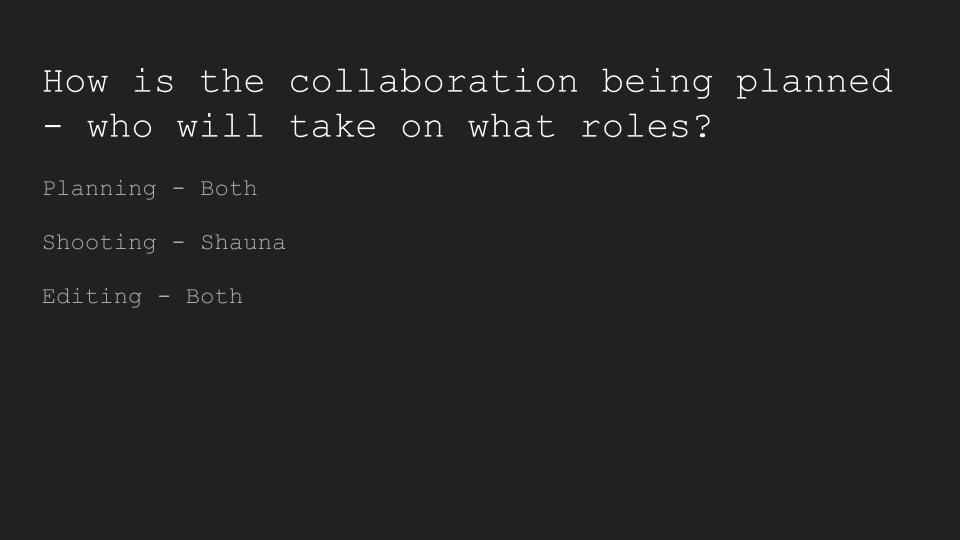
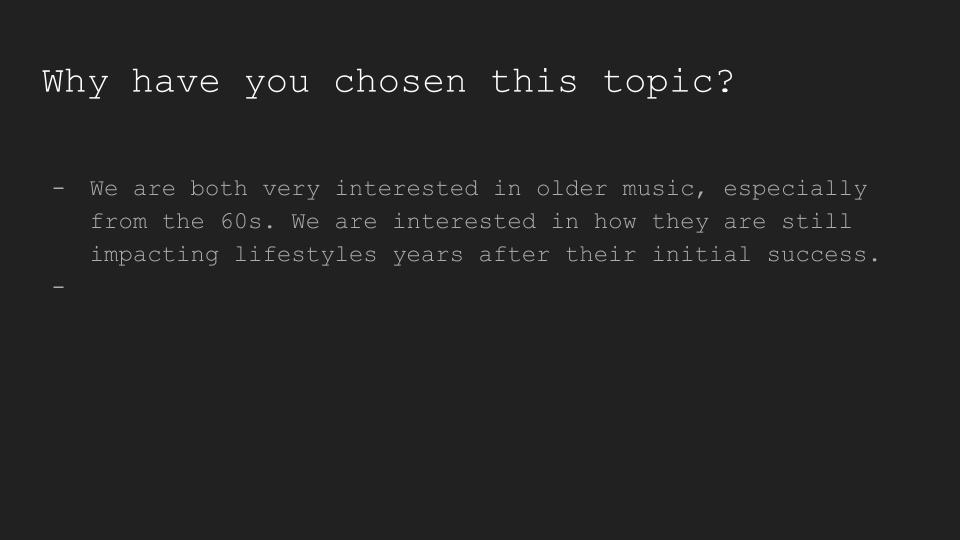
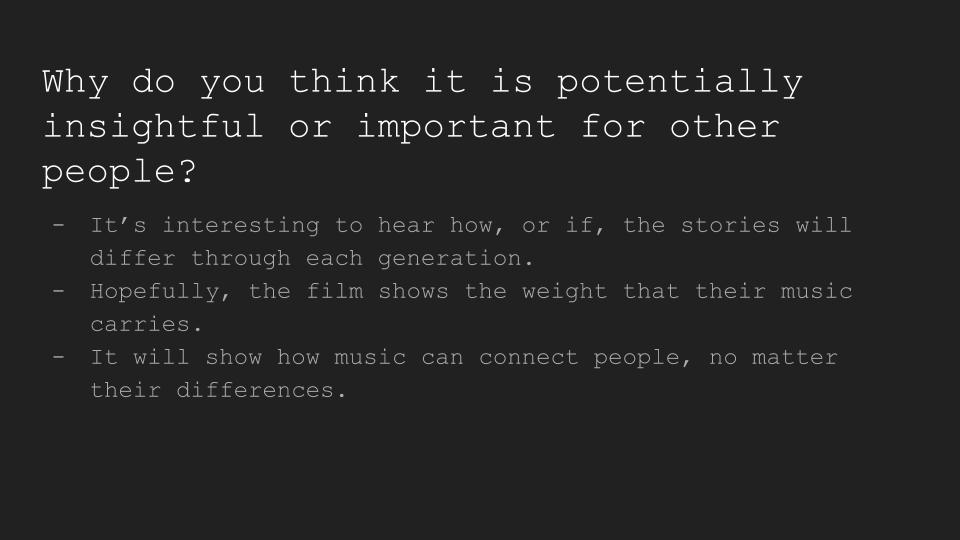
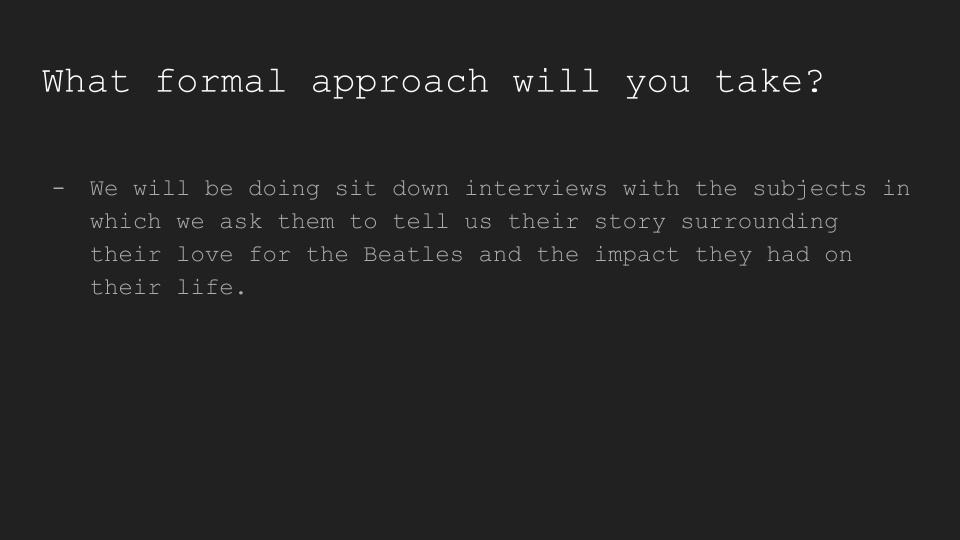
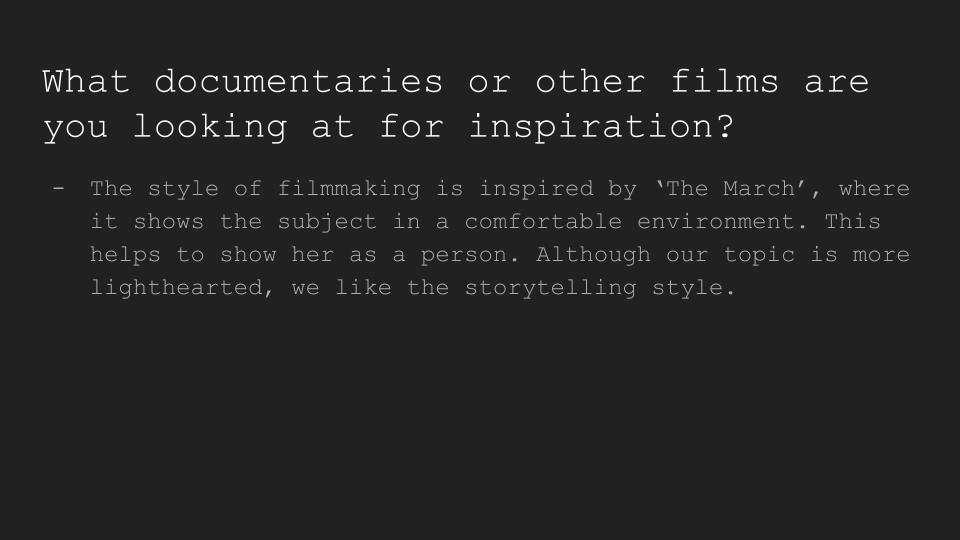
When writing our presentation it was easy to think about the general baseline for our documentary. Obviously not knowing what was in store with Covid-19 we did have a solid. idea before and then once we were separated we just changed the idea slightly. This meant that what we wrote in our power point mostly still corresponds with what we actually made.
Going back to the power point I would have added in some more minute details about audience and what other documentaries we. took inspiration from.
Week 5
What are some issues with representing other people that may arise in your final project? What might some potential solutions be?
In my final project we need to careful as we are using the general public that have sent in their stories about their love for The Beatles. This means that we will need to make sure we don’t shine these people in a negative light and if we are using their images. or voices that we give them the correct information about where their likeness is going to be used.
Representing a band that is so well loved and also surrounded with controversy means we will have to respect that not everyone has the same opinions about The Beatles. What with the assassination and the problems with drugs and even controversies that Paul McCartney died and was replaced by an imposter, this meant that the band may have many loyal fans but also will have offended some people along the way. Our documentary should show them in a positive light however never glorifying the negatives.
Week 4
This week we explored sound. We learnt how to use the equipment and then went out to Devils Point to explore the different textures and soundscapes of the ocean. This not only allowed us to get more familiar with the equipment it allowed us to think about the technicalities behind sound and how much it can aid a visual film.
This gave me a lot to think about when it comes to making my final documentary and actually everything I make from now on. It gave me the chance to learn the equipment and be able to think about what sound can add to things.
WEEK 3
This week we filmed an interview and needed to use classic techniques. We filmed the interview from two different angles. One 90 degrees from the subject and one straight on. We did this so that we could have the subject seen from several angles which makes the audience feel more involved as they are seeing the action like they are in the room as well.
We also included cut aways of the subjects which meant that the interview got cut up and wasn’t just talking for ages. It gave the audience something to focus on while the interview was happening.
Here is the interview, we interviews Amin about being a drama student and how he made a switch from Anthropology to Drama.
Unfortunately one big problem was the sound. We gave Amin the phone to record the sound and he held it towards him to every time he moves the material of his jumper crinkles so we miss some of the dialogue. This is something to learn from and think about in our final documentary.
WEEK 2
In a documentary filmmaking situation, what might a filmmaker do that would change them from a “fly on the wall” to a “hornet that stings”?
In documentaries often a less involved approach is better, just following the action letting it happen as the filming is done. This often means that the documentary shows a more realistic version of the subject. Seeing the honest work as it naturally happens, however changing that approach also may enable the filmmakers to get the most out of the subject. For example asking them questions may force the subject to go deeper into the topic or explore something further than they would have done.
I think that both approaches are very helpful when documenting people and what they are doing. A less invasive approach helps as the audience can see the truth and see without interference on what the subject should or shouldn’t say.
A more invasive approach is helpful to get information that the subject otherwise wouldn’t give if they were left to say what they wanted. This means that the filmmaker can ask pressing questions to get deeper answers.
Week 2
As you start to think about your final documentary project, what type of approach might be most appropriate and why?
Starting to think about the final documentary project I want the documentary to be a very personal approach but still fell very casual. I would like to have sit down interviews but also have the interviewee to be filmed doing things in their daily life to give off the impression that these are normal people who all have something in common.
A documentary about the relationship between music and the impact it has on vastly different generations, needs to be a relaxed affair as we want to hit all the emotional connections to the music, not just the fact they like it.
Week One
How is the relationship between the subject and the documentary filmmaker treated in The Beaver Trilogy? What might be inferred by the viewer?
The relationship between the filmmaker and the subject is a tricky one because I feel as though the subject wanted a better relationship and he got more out of it. I think the filmmaker was just using him for a program and as though it was nothing but showbiz, I felt it started as something of a joke. As the film went on and the second part started a bigger relationship was explored, with them even keeping in contact after the documentary ended. This relationship seemed better than in the real version as it actually had some depth to it. The viewer gets a sense that his feelings aren’t being taken into account. He is clearly going through some things that the viewer should be able to pick up on. The documentary makers only want to make a program. and I feel it was making a mockery of him. The relationship is shown more in part three, this is when it goes way more into his life after everything is all done. It shows the struggles he faced while filming and just doing what he loved.
 Elle's Documentary Blog